Privacy and spend
Every route out of your machine is off until you switch it on. You can see each time data leaves. Nothing is spent without a gate you control.
Live run end to end in the real appBuilt in the code, covered by testsBuilt, not run live tested against stand-insIn progress being built now
Every route is opt-in Built
The Lampway server sends nothing to another machine unless that route is switched on. Model providers, studios, cloud boxes and the download of model weights are each a route, and each starts switched off. A model on your own machine needs no route.
The check sits at one point: every request the server makes passes through it, and so do the programs it starts that talk to the network: the studio drivers, the local agent CLIs and the cloud-box CLI. A route that is off refuses with “switch it on in Privacy to let data leave”, and nothing is sent. A host that is not in the route table is refused too, never guessed.
- OpenRouterprivate assets only to zero-retention endpoints
- Higgsfieldretention unknown: its terms are not recorded yet
- Tripo Studioretention unknown: its terms are not recorded yet
The same three rules as the server: a route that is off refuses; a private asset goes only where it cannot be kept; the log row is written before anything leaves.
You can see when data leaves Built
Every send writes a row to the egress log before the first byte leaves: the route, the host, the kind (image, video, mesh, text, file), the byte count, the asset ids and the retention class of that route. The log never holds the content, a query string or a header. Refusals are logged the same way, with the reason.
The Privacy panel in Lampway’s sidebar lists every route with its switch and what the provider keeps, shows “DATA LEAVING” while a send is in flight and “nothing is leaving this machine” otherwise, shows the last log rows, and exports the whole log as JSON lines.
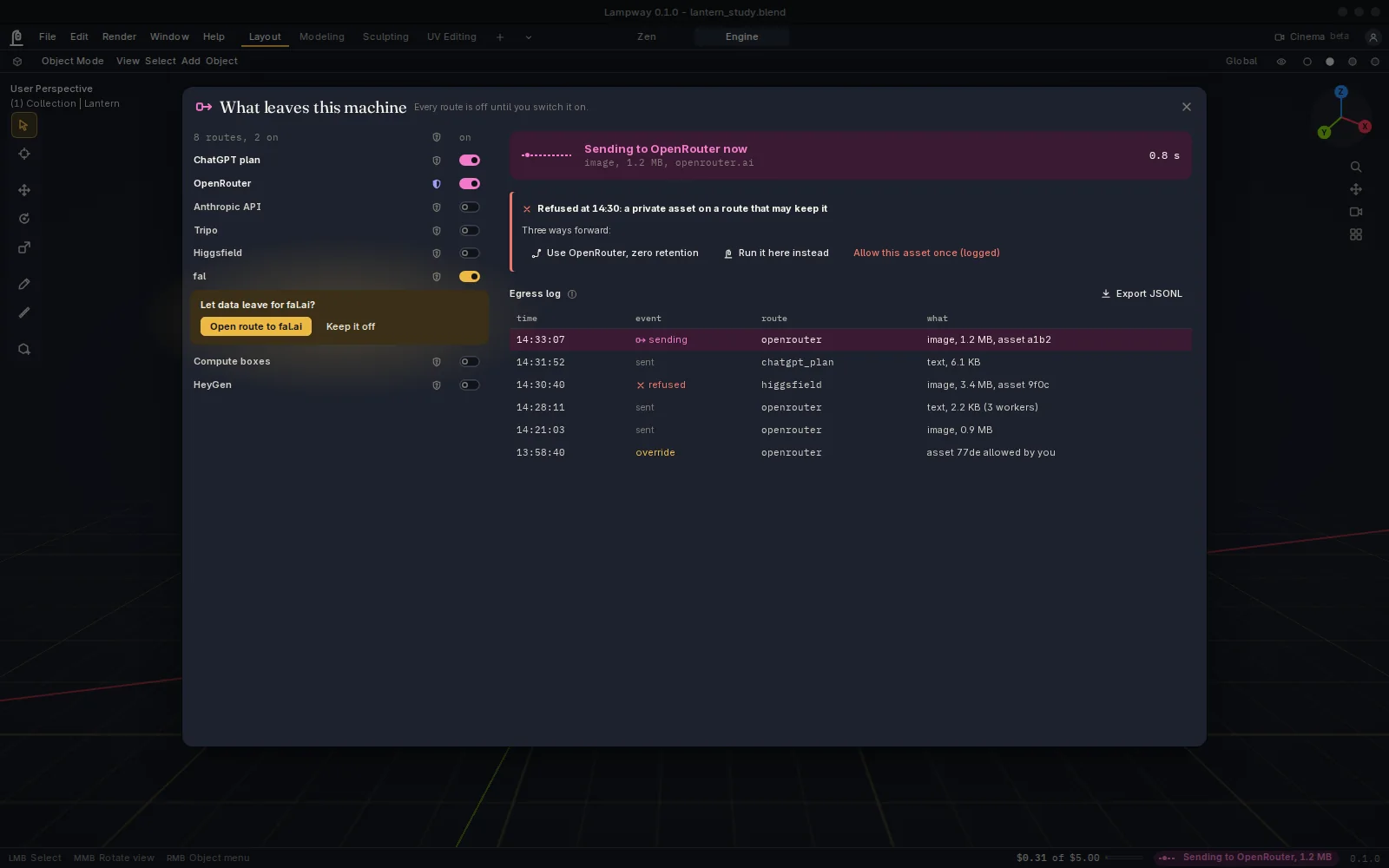
Private assets stay where they cannot be kept Built
- A request that carries a private asset is refused on any route that may keep it.
- On OpenRouter, a private request carries
{"zdr": true, "data_collection": "deny"}: only zero-data-retention endpoints may serve it, and the provider may not collect it. Free (:free) models are never used for private content. - The small judge that picks one answer from a closed set of options computes its eligible models live from OpenRouter’s zero-retention endpoint list. When none qualifies, it refuses and sends nothing. Built, not run live
- You can allow one asset on one route. That allowance is its own log row, and you can withdraw it.
Every route, and what it keeps
“Unknown” means the provider’s terms have not been read and recorded yet. Private assets are refused on those routes unless you allow them one asset at a time.
| Route | Goes to | What it keeps |
|---|---|---|
| OpenRouter | openrouter.ai | Per model. Private requests go to zero-retention endpoints with data collection denied. |
| ChatGPT plan | chatgpt.com, OpenAI | Unknown |
| Claude plan | api.anthropic.com, claude.ai | Unknown |
| Custom model endpoint | the server you configured, when it is not on this machine | Unknown |
| MCP connection check | an MCP server you configured | Sends only the handshake and the tool list; none of your content and no credential |
| Tripo Studio | tripo3d.ai | Unknown |
| Meshy | meshy.ai | Unknown |
| Hi3D | hitem3d.ai | Unknown |
| Hyper3D / Rodin | hyper3d.ai | Unknown |
| Higgsfield | higgsfield.ai | Unknown |
| HeyGen | heygen.com | Unknown |
| fal | fal.ai | Unknown |
| Model weights download | Hugging Face | No content of yours is sent; the host sees your IP address and which file you asked for |
| Boat (cloud CPU box) | boat.dev | A box with snapshots off is erased when it stops; what happens to content in flight is not recorded |
| Modal | modal.com | Unknown |
| RunPod | runpod.io | Unknown |
Spending is gated
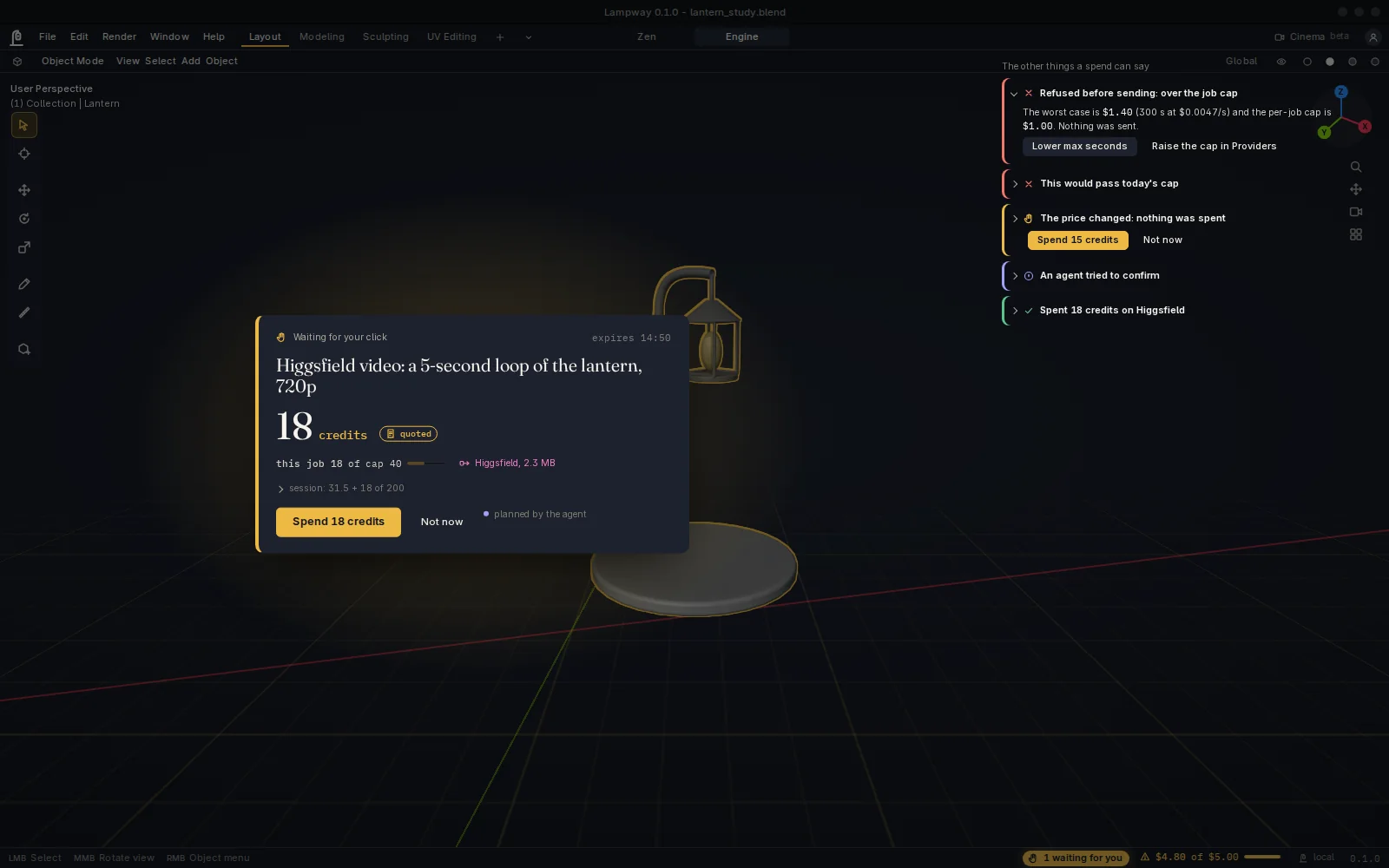
- StudiosTripo, and Meshy, Hyper3D and Hi3D over REST: always a click. The price on the button must equal the price the studio read back, the approval is one-shot and expires after ten minutes, and no agent tool can confirm. Where a studio publishes no price, you set the most you will accept.
- HiggsfieldAlways a click, after the price is read back with its own cost call.
- OpenRouterA generation job priced above $0.25 waits for your click; an image job is judged by its estimated price. Every request also carries a token cap, and past the session ceiling (default $3) every call is refused before it is sent.
- Video jobsA job whose estimate is over $2 is refused before it is sent.
- Compute boxes$1 a job, $5 a day, and a click for anything above $0.25. A job whose worst case passes a cap is refused before a box is rented. Live
- AgentsThe agent can plan a job and read its price and status. It cannot confirm a studio spend or submit a compute job.
- ReceiptsEvery paid job gets a receipt on disk before it is sent. After a crash, a job whose submission is unknown is never sent again; you say whether it ran.
Caps and click rules are per provider, in the Providers dialog.
What this does not cover
- The gate covers the Lampway server and the studio, agent and cloud-box programs it starts. Blender’s own network features sit outside it, and they have not been audited.
- Most providers’ terms have not been read and recorded, so their routes say “unknown”.
- The request shapes for fal, Meshy, Hyper3D, Hi3D, Tripo over REST, Modal and RunPod are written from their documentation and have not been run against the real services.
- The Privacy panel refreshes from the server; it is not a live stream.
Read more
- Privacy and routes: switching a route on, the log, the per-asset allowance.
- Spend: caps, clicks and receipts per provider.
- Compute: renting a box, Blender offload, reconcile.
- Privacy policy: what the app and this website collect.